

IP Transition

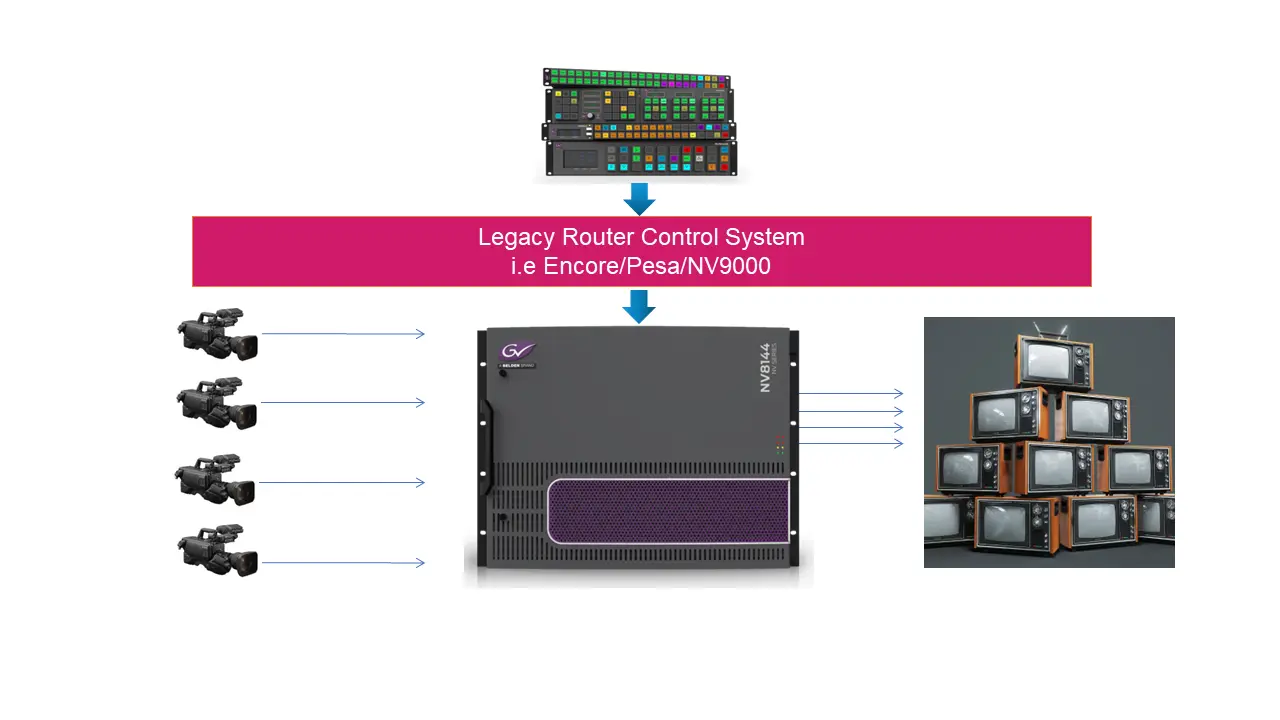
Traditional Baseband Routing

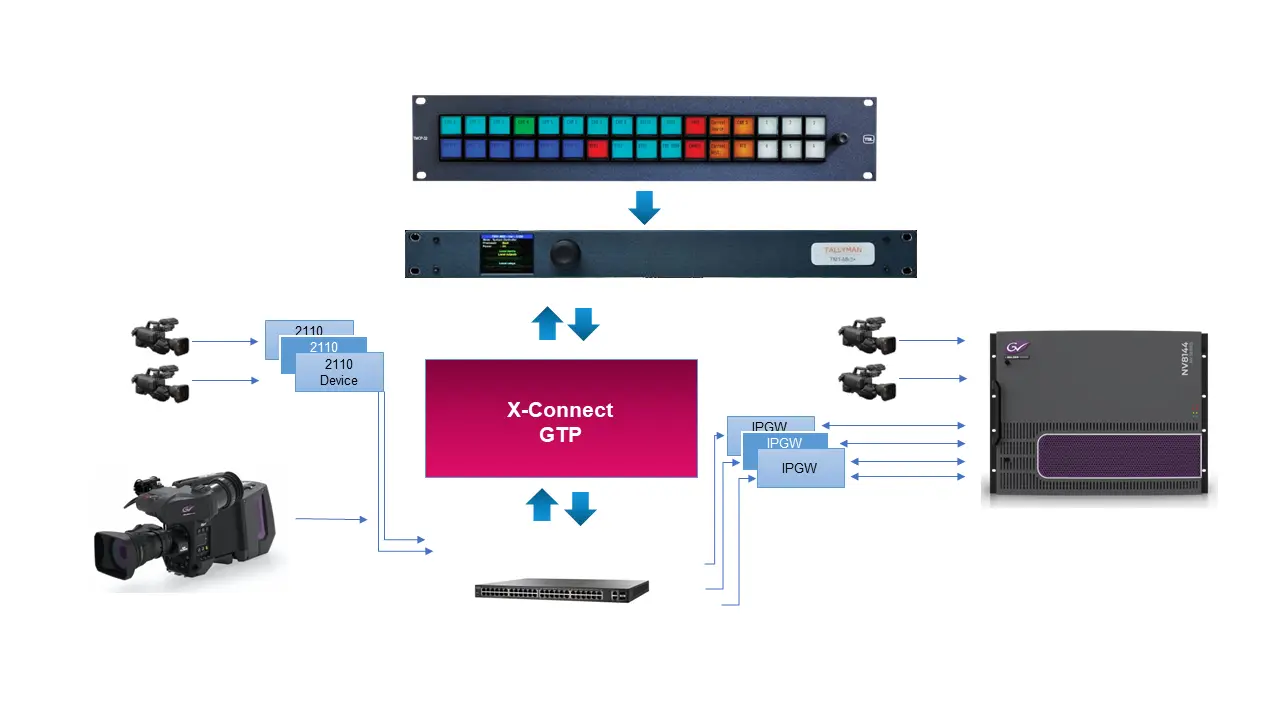
X-Connect IP Gateway

More case studies featuring this application:
- Turkuvaz Media Group Invests in TSL’s Audio Monitoring and Control Solutions to Future-Proof Their Operations
- Major Financial Firm Deploys TSL Control for Hybrid Facilities
- First Baptist Church of Jacksonville Deploys TSL Control
- Central Christian Church Deploys TSL Control
- Berklee College of Music (NYC) Deploys TSL Control to Seamlessly Transition to IP Routing
- High-Quality Video Routing and Control for Leading Financial Corporation
Have Questions?
Grab a quick slot with our tech team.
Have Questions?
Grab a quick slot with our tech team.
Modern broadcasting technology offers a huge range of signal types which can vary hugely in complexity and that can have a big effect not only on the supporting engineers but the operational staff who are making the content. TSL Control offers a manufacturer-agnostic and cost-effective approach to the control of routing media regardless of format. Discover more
TSL hardware panels give you solutions to niche problems in a simplified way, allowing control of external devices from the button panels without having to go via a control system. It’s direct control. They have their own logical functions and GPIO. Plus, a wide variety of comms mechanisms, that can talk of over IP, over serial and over GPIO. With a small footprint and big performance, the panels can control any GPIO, IP, RS422, or RS232-enabled device, located anywhere, with a single button push.
VIRTUAL PANELS
The TallyMan Virtual Panel (TMVP) is an incredibly powerful addition to the TallyMan control system. The fully customisable user interface brings signal flow management, monitoring and device management to users in an intuitive control surface, enhancing operational workflow to bring flexibility to outside broadcast and transmission facilities throughout the world. Discover more
The modern broadcast system contains a vast array of devices that either produce, display or “consume” tallies. Most of these devices will produce or receive the tally information in different ways using different protocols and interfaces. Tally requirements can be very small and contained, but some can be very large systems that are spread across geographical locations. Discover more
Broadcasters deploying ST 2110 infrastructure face complex challenges in orchestrating media flows across diverse IP endpoints. TSL provides a scalable and cost-effective control layer that simplifies IP routing, reduces training overhead, extends the life of legacy systems, and accelerates adoption of ST 2110 without operational disruption. Discover more
A broadcaster may wish to have an array (or pool) of devices that can be dynamically allocated or routed flexibly on a production-by-production basis. These devices may be from different manufacturers (EVS, Evertz, Grass Valley, Black Magic etc) and have different control panels, interfaces, and protocols. Discover more
For broadcasters navigating the thrilling world of live sports and news, the unpredictability of highly reactive content can make signalling ad insertion challenging. Rapid changes in content increase the likelihood of failing to deliver ad breaks at the right time, risking reputational damage with advertisers. Discover more
The modern operator can be faced with a bewildering array of control surfaces, web pages and graphical user interfaces to control even a simple production. This can lead to delays and errors, affecting production values and output, and perhaps even causing a financial penalty (service Credits) from the broadcasters' customers. Discover more
Most broadcasters have a wide variety of new and legacy equipment that they need to work together in one cohesive system. These devices will utilise a vast array of different protocols and interfaces, everything from GPIs to xml. Do you need to use your old Evertz control panel with your new Grass Valley Router? Do you need to control your graphics keyer when it is routed to air? This all requires some form of protocol translation. Discover more
Monitoring the status of devices within a broadcast system is vital to its operation: Do you want to know where a fault occurs with a broadcast chain, which device has lost its input or reference, and whether there has been silence on a channel for too long? Has the power supply failed in a key unit? Discover more
More and more broadcasters are moving to IP-based infrastructure over traditional SDI. The promise is that the equipment required (IP switches, router etc.) are more cost-effective than their SDI equivalent as well as opening up broadcast to a huge amount of industry standard tools that are used in the IT industry. The problem is that doing reliable real-time media over IP is hard. There is a significant learning curve and a very different methodology used than with SDI. Discover more
Broadcasters may have a number of record/replay devices (DDRs) that they wish to control from a remote operational position, this device could be from a number of different manufacturers (EVS, Blackmagic, Evertz and GrassValley to name a few). It is common practice to bring in rental equipment for some productions, so the make and model can change frequently. Discover more
Many broadcasters need to provide a disaster recovery playout chain but cannot afford a full additional channel of automation from one of the larger broadcast manufacturers. Discover more
Modern broadcast systems often require reconfiguration, for example, where a production gallery switches the studio floor it has been assigned to or where you switch to a backup system. This action requires the reconfiguration of multiple devices or systems, which can be complex and time-consuming. Discover more
Modern live news networks will prepare many graphics ahead of time for potential future events, such as various outcomes of elections or sporting events. Managing this workflow and ensuring that the proper versions of graphics make it to air can often fall on the graphics department which can make their daily work more complicated. Discover more
One of the primary pillars of modern broadcast workflows is reducing the number of manual functions that operators are responsible for. Many functions happen on a daily or weekly basis at specific times of day and can be easily automated to free operators up for more important tasks. Discover more
From signal routing to remote device control, by grouping multi-level actions into a single, user-configurable interface, you can do things that will make your production much more efficient. By providing just the controls needed, from simple interfaces for specific tasks to unleashing the full power of a system built on a logic-based and open control layer, customers are able to maintain complete ownership of their systems.
Our Solutions
Audio Monitoring
Listen, measure, control and troubleshoot with award-winning AMUs

Control Solutions
Flexible, modular vendor agnostic applications and interfaces for control, orchestration, automation, monitoring and disaster recovery

Power Management
Intelligent PDU solutions with remote control and monitoring
Our Commitment to Excellence
With an impressive history of industry awards and a dedication to pushing the boundaries of what's possible, TSL stands as a beacon of innovation. Our installed user base and repeat customers are testaments to our leadership in developing solutions that meet and exceed our clients' expectations worldwide.
Join us as we continue to listen to, enable, and empower professionals across the globe with superior technology that anticipates the future needs of their industry.

Testimonials
Trusted By